Serenity: The Fiddler
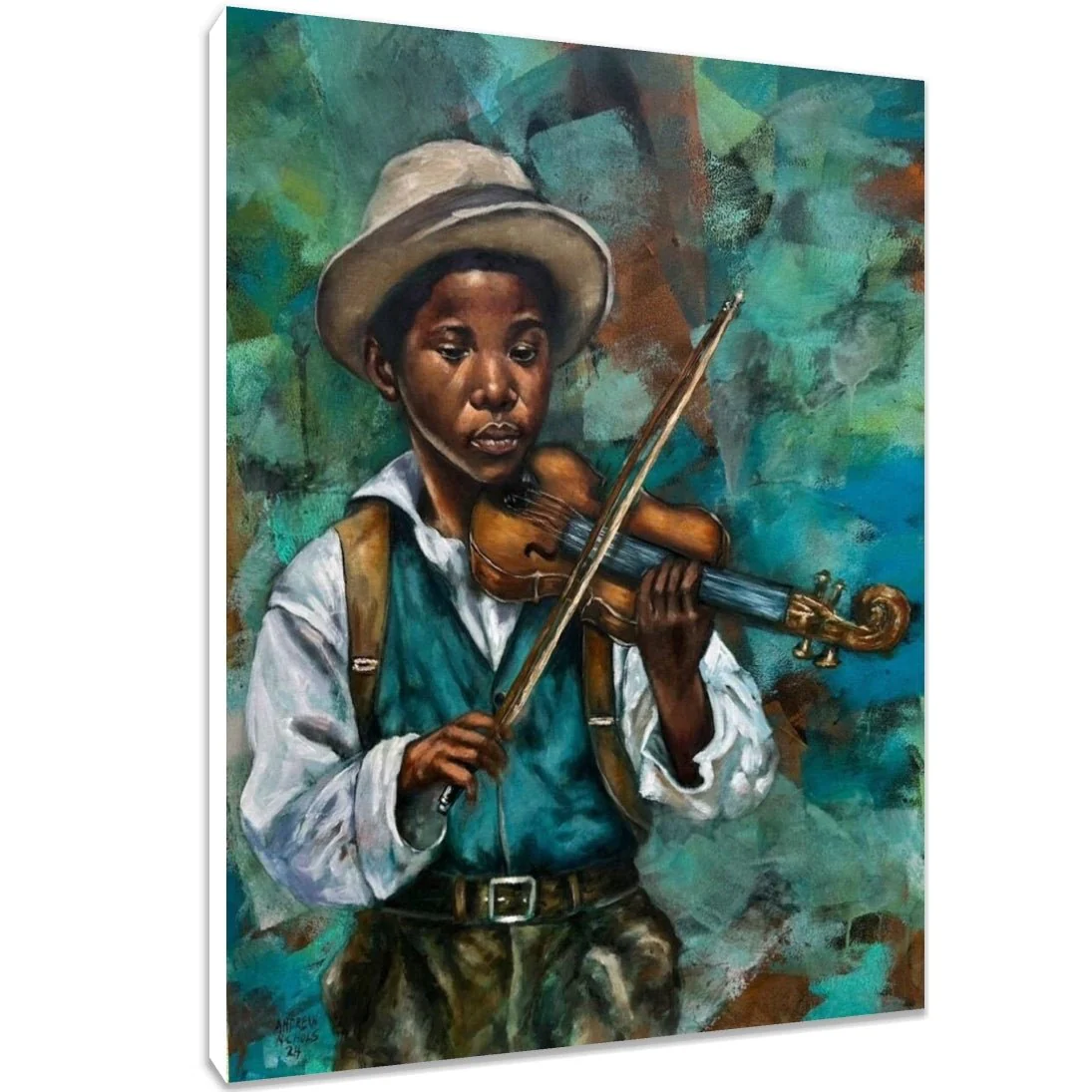
There is a boy in this painting, lost in his music. His hat is tilted just so, his eyes are cast downward in concentration, and the fiddle rests against his chin as naturally as breathing. Artist Andrew Nichols titled this piece Serenity, and the title earns every note.
The fiddle carried enormous weight in African American history. Enslaved people turned to music as a source of recreation, singing and dancing jigs and reels to the fiddle, the banjo, and the tambourine. But the role of the Black fiddler ran far deeper than entertainment. Historians find a surprising number of runaway notices hidden in the songs of these enslaved musicians, particularly fiddlers, because the violin was a go-to instrument at social gatherings, not just for enslavers but also for the enslaved themselves. Skilled fiddlers were hired out to play at parties and weddings, earning them a degree of mobility and access that most enslaved people were never granted.
Filmmaker Eduardo Montes-Bradley, whose documentary explores this history, has said, "We need to look at the fiddle, the violin, as an instrument of liberation in a sense, and freedom." The violin offered hope to enslaved musicians planning an escape; if you could make it to freedom, music was how you would survive.
The music carried messages, too. Spirituals were coded with hidden messages about maps, navigational strategies, and timing for those seeking escape toward freedom in the Northern States and Canada. Songs that sounded like simple hymns were, beneath the surface, a sophisticated system of resistance and communication, embedded with directions to freedom, advice on evading capture, and spiritual encouragement for those seeking liberation.
White slaveholders found singing slaves amusing, never fully grasping what was being communicated right in front of them.
One of the most remarkable stories from this era involves an enslaved man named Sawney Freeman. Sawney was not only a fiddler but also a composer. In 1801, an advertisement appeared in the Connecticut Journal for something called the "Musician's Pocket Companion," written by Sawney Freeman, a free man of color, making him one of the earliest published Black composers in the United States.
In Serenity, Nichols gives us a young fiddler absorbed in something private and pure. The turquoise and teal abstracted background pulses around him, as though the music itself has become atmosphere. This boy is communing with something larger than himself as he plays, carrying a tradition that survived bondage, outlasted oppression, and helped shape the very sound of American music.
Andrew Nichols was born and raised in Brooklyn, New York, where his artistic gift surfaced early. He began expressing himself through pencil on paper in elementary school. He soon began receiving formal art awards, his first at age nine. His work explores the multifaceted experiences of the African diaspora, with themes of identity, resilience, and cultural heritage woven through every canvas.
Nichols is particularly celebrated for his paintings of children, bringing tenderness and dignity to young Black figures that resonate deeply with collectors and families alike.
This premium giclee canvas print is available in two sizes, 24x30 inches or 30x40 inches, and can be ordered as a stretched canvas or as a stretched canvas set in a sleek black floater frame. Both options arrive ready to hang and become an immediate focal point in any room.
Product Information
Product Information
Shipping & Returns
Shipping & Returns
Serenity: The Fiddler
Serenity: The Fiddler
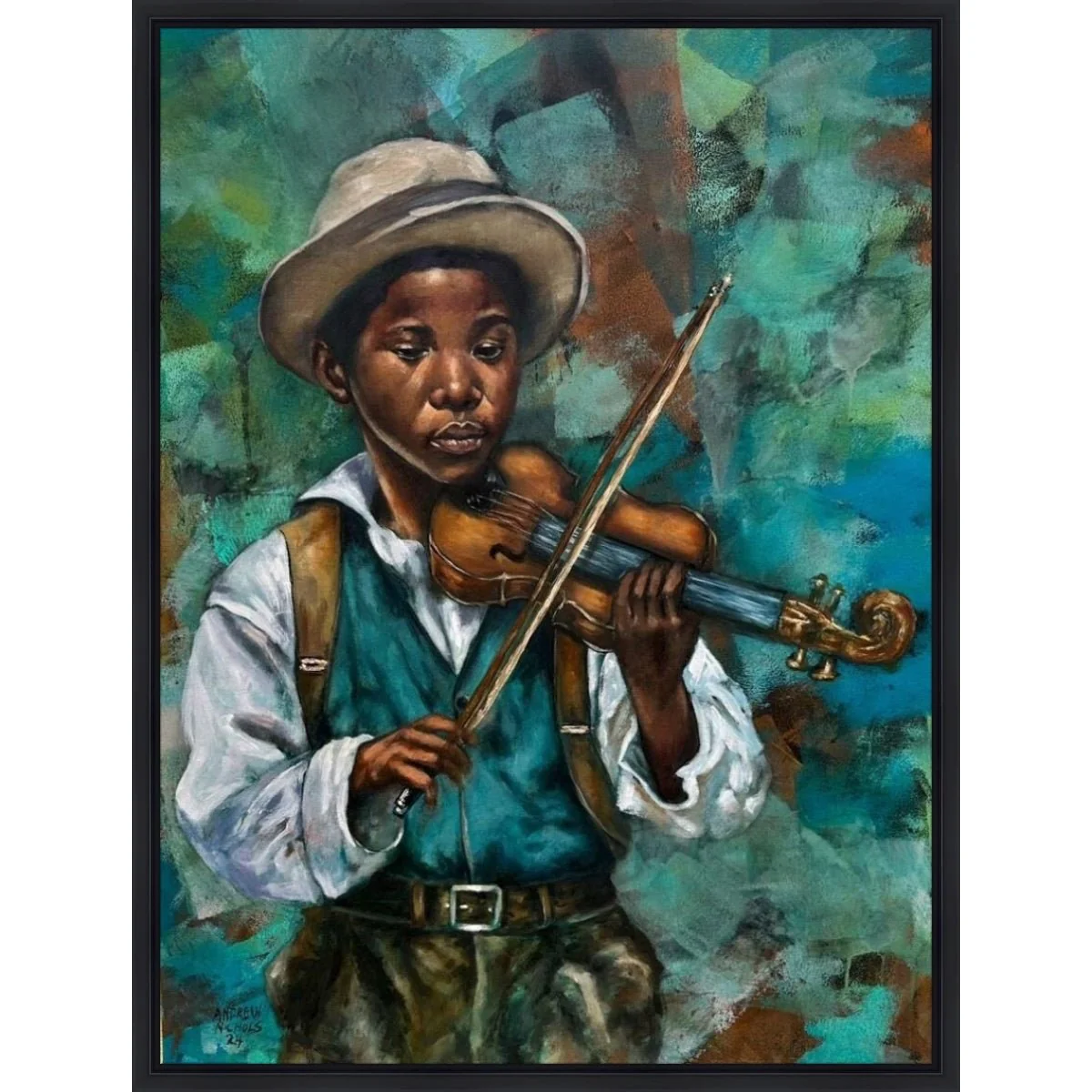
There is a boy in this painting, lost in his music. His hat is tilted just so, his eyes are cast downward in concentration, and the fiddle rests against his chin as naturally as breathing. Artist Andrew Nichols titled this piece Serenity, and the title earns every note.
The fiddle carried enormous weight in African American history. Enslaved people turned to music as a source of recreation, singing and dancing jigs and reels to the fiddle, the banjo, and the tambourine. But the role of the Black fiddler ran far deeper than entertainment. Historians find a surprising number of runaway notices hidden in the songs of these enslaved musicians, particularly fiddlers, because the violin was a go-to instrument at social gatherings, not just for enslavers but also for the enslaved themselves. Skilled fiddlers were hired out to play at parties and weddings, earning them a degree of mobility and access that most enslaved people were never granted.
Filmmaker Eduardo Montes-Bradley, whose documentary explores this history, has said, "We need to look at the fiddle, the violin, as an instrument of liberation in a sense, and freedom." The violin offered hope to enslaved musicians planning an escape; if you could make it to freedom, music was how you would survive.
The music carried messages, too. Spirituals were coded with hidden messages about maps, navigational strategies, and timing for those seeking escape toward freedom in the Northern States and Canada. Songs that sounded like simple hymns were, beneath the surface, a sophisticated system of resistance and communication, embedded with directions to freedom, advice on evading capture, and spiritual encouragement for those seeking liberation.
White slaveholders found singing slaves amusing, never fully grasping what was being communicated right in front of them.
One of the most remarkable stories from this era involves an enslaved man named Sawney Freeman. Sawney was not only a fiddler but also a composer. In 1801, an advertisement appeared in the Connecticut Journal for something called the "Musician's Pocket Companion," written by Sawney Freeman, a free man of color, making him one of the earliest published Black composers in the United States.
In Serenity, Nichols gives us a young fiddler absorbed in something private and pure. The turquoise and teal abstracted background pulses around him, as though the music itself has become atmosphere. This boy is communing with something larger than himself as he plays, carrying a tradition that survived bondage, outlasted oppression, and helped shape the very sound of American music.
Andrew Nichols was born and raised in Brooklyn, New York, where his artistic gift surfaced early. He began expressing himself through pencil on paper in elementary school. He soon began receiving formal art awards, his first at age nine. His work explores the multifaceted experiences of the African diaspora, with themes of identity, resilience, and cultural heritage woven through every canvas.
Nichols is particularly celebrated for his paintings of children, bringing tenderness and dignity to young Black figures that resonate deeply with collectors and families alike.
This premium giclee canvas print is available in two sizes, 24x30 inches or 30x40 inches, and can be ordered as a stretched canvas or as a stretched canvas set in a sleek black floater frame. Both options arrive ready to hang and become an immediate focal point in any room.
Original: $1,010.00
-70%$1,010.00
$303.00Product Information
Product Information
Shipping & Returns
Shipping & Returns
Description
There is a boy in this painting, lost in his music. His hat is tilted just so, his eyes are cast downward in concentration, and the fiddle rests against his chin as naturally as breathing. Artist Andrew Nichols titled this piece Serenity, and the title earns every note.
The fiddle carried enormous weight in African American history. Enslaved people turned to music as a source of recreation, singing and dancing jigs and reels to the fiddle, the banjo, and the tambourine. But the role of the Black fiddler ran far deeper than entertainment. Historians find a surprising number of runaway notices hidden in the songs of these enslaved musicians, particularly fiddlers, because the violin was a go-to instrument at social gatherings, not just for enslavers but also for the enslaved themselves. Skilled fiddlers were hired out to play at parties and weddings, earning them a degree of mobility and access that most enslaved people were never granted.
Filmmaker Eduardo Montes-Bradley, whose documentary explores this history, has said, "We need to look at the fiddle, the violin, as an instrument of liberation in a sense, and freedom." The violin offered hope to enslaved musicians planning an escape; if you could make it to freedom, music was how you would survive.
The music carried messages, too. Spirituals were coded with hidden messages about maps, navigational strategies, and timing for those seeking escape toward freedom in the Northern States and Canada. Songs that sounded like simple hymns were, beneath the surface, a sophisticated system of resistance and communication, embedded with directions to freedom, advice on evading capture, and spiritual encouragement for those seeking liberation.
White slaveholders found singing slaves amusing, never fully grasping what was being communicated right in front of them.
One of the most remarkable stories from this era involves an enslaved man named Sawney Freeman. Sawney was not only a fiddler but also a composer. In 1801, an advertisement appeared in the Connecticut Journal for something called the "Musician's Pocket Companion," written by Sawney Freeman, a free man of color, making him one of the earliest published Black composers in the United States.
In Serenity, Nichols gives us a young fiddler absorbed in something private and pure. The turquoise and teal abstracted background pulses around him, as though the music itself has become atmosphere. This boy is communing with something larger than himself as he plays, carrying a tradition that survived bondage, outlasted oppression, and helped shape the very sound of American music.
Andrew Nichols was born and raised in Brooklyn, New York, where his artistic gift surfaced early. He began expressing himself through pencil on paper in elementary school. He soon began receiving formal art awards, his first at age nine. His work explores the multifaceted experiences of the African diaspora, with themes of identity, resilience, and cultural heritage woven through every canvas.
Nichols is particularly celebrated for his paintings of children, bringing tenderness and dignity to young Black figures that resonate deeply with collectors and families alike.
This premium giclee canvas print is available in two sizes, 24x30 inches or 30x40 inches, and can be ordered as a stretched canvas or as a stretched canvas set in a sleek black floater frame. Both options arrive ready to hang and become an immediate focal point in any room.